 Acreonix
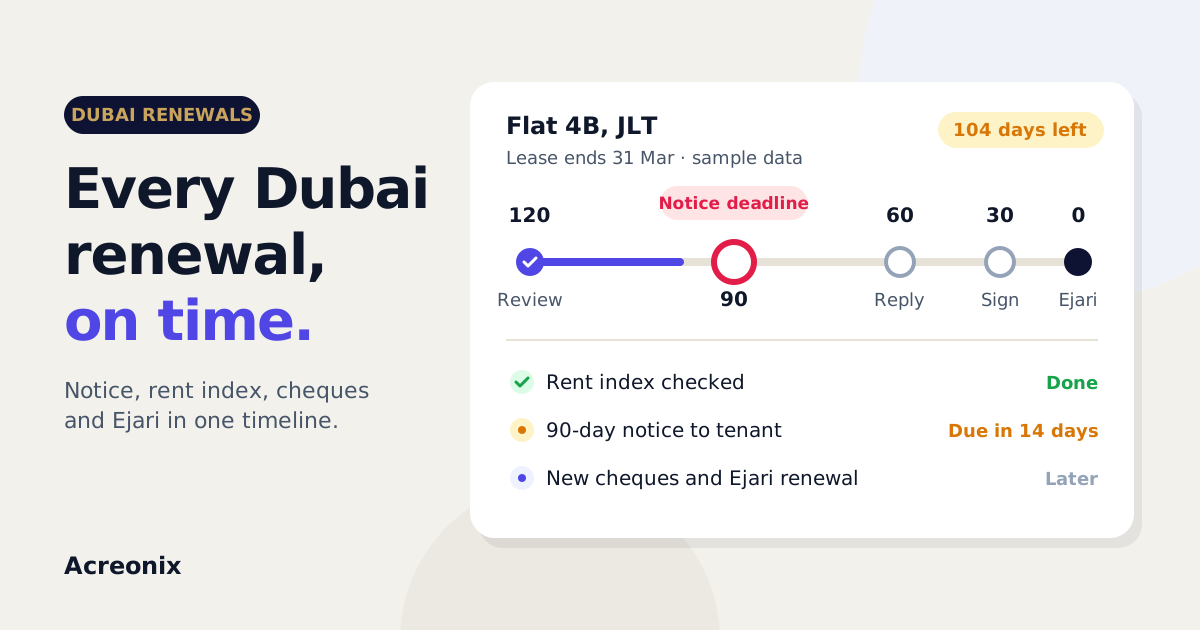
A tenancy renewal in Dubai means agreeing the next term with the tenant, confirming any change to rent or terms within the legal notice period, issuing the renewed contract and registering it again with Ejari. Under Dubai's tenancy law, a landlord who wants to change the terms, including the rent, is generally required to tell the tenant at least 90 days before the contract expires, and any rent increase must sit within the limits set by the official RERA rental index. Good managers start well before that mark.
This guide covers a practical renewal timeline, the rent increase rules, Ejari renewal and how to track renewals across a portfolio. It is general information, not legal advice. Rules change, so check the current position with the Dubai Land Department (DLD) and RERA before acting.
What does the law say about tenancy renewal in Dubai?
Residential and commercial tenancies in Dubai are governed mainly by Law No. 26 of 2007, as amended by Law No. 33 of 2008. At a general level, the points that matter most for renewals are:
- Notice of changes. If either party wants to amend the terms at renewal, such as the rent or the payment schedule, the law requires notice at least 90 days before the contract ends, unless the parties agree otherwise. Miss that window and you may not be able to change the terms for the coming year.
- Automatic continuation. If the tenant stays on after expiry and the landlord does not object, the contract is generally treated as renewed on the same terms, for the same period or one year, whichever is shorter.
- Ending a tenancy is separate. Asking a tenant to leave is only allowed on specific grounds, with a much longer, formally served notice. Handle it with legal advice.
- Rent increases are capped. Increases at renewal are limited by a decree that links the permitted increase to the official rental index.
Treat this as a starting point. The law and how it is applied can change, and contracts may add their own terms. Confirm the current rules on the Dubai Land Department website or through the Dubai REST app, and take advice for disputed or unusual cases.
When should you start a tenancy renewal?
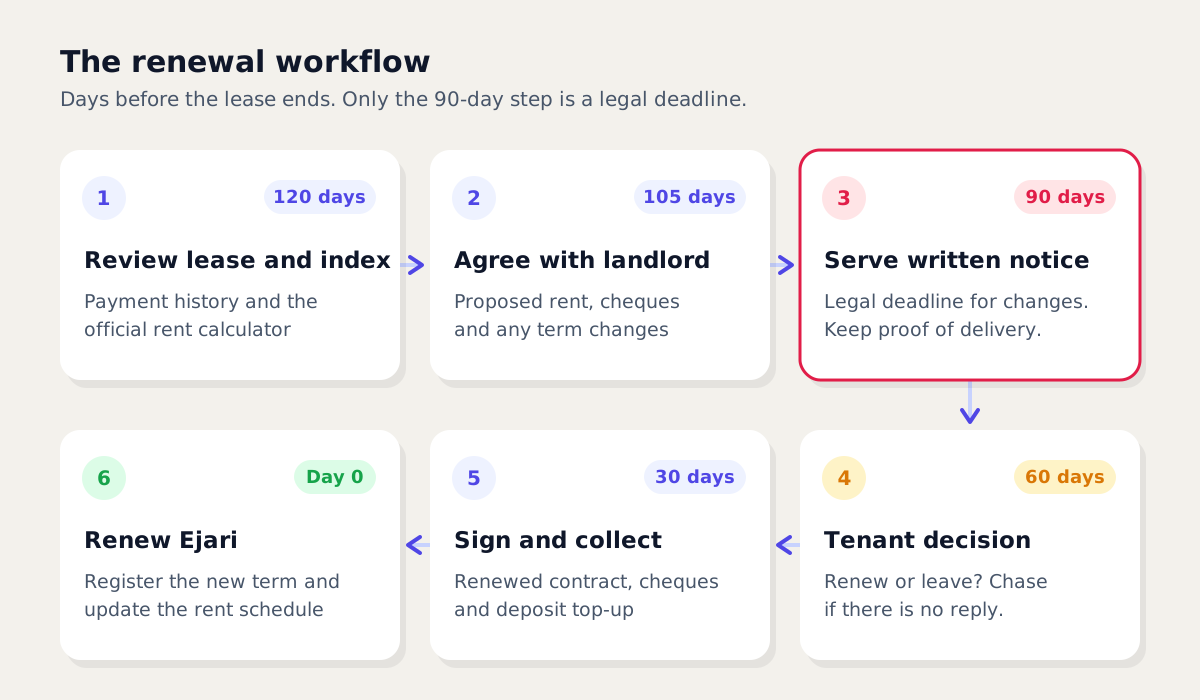
Start at 120 days. The 90-day point is a legal deadline for notice of changes, not the moment to begin. An extra month lets you check the rental index, agree a position with the landlord and send a clear notice with time to spare.
| Days before expiry | What happens | Who owns it |
|---|---|---|
| 120 | Renewal opens. Check the lease, payment history and current index position. | Property manager |
| 105 | Agree the renewal position with the landlord: rent, cheques, any term changes. | Manager and landlord |
| 90 | Deadline to serve written notice of any change to terms or rent. Keep proof of delivery. | Property manager |
| 60 | Tenant confirms renewal or notice to leave. Chase if there is no reply. | Leasing or PM team |
| 30 | Renewed contract signed, cheques or payment plan collected, Ejari renewal under way. | PM and admin |
| 0 | New term starts with a registered contract and an updated rent schedule. | Admin |
Only the 90-day step is a legal deadline; the rest are working targets. Keep the order: decide, notify, confirm, sign, register.
How does the RERA rent increase calculator work?
At renewal, the permitted increase depends on how far the current rent sits below the average market rent for similar properties in the same area, as measured by the official rental index. If the unit is already at or close to the average, no increase is allowed. The further below the average it is, the larger the increase the rules permit, up to a maximum band.
The bands are set by Decree No. 43 of 2013, and the DLD publishes the calculation through its rental index tools. Its newer smart rental index rates individual buildings, so the comparison is more specific than a simple area average.
So do not work out the cap from a portal search or a spreadsheet. Use the official rental increase calculator on the DLD website or in the Dubai REST app, and save a copy of the result with the renewal file.
A worked example, using illustrative figures only:
- A two-bedroom flat is let at $27,000 a year.
- The official calculator shows an average rent for comparable units that is well above that figure.
- The calculator returns the maximum increase allowed for this renewal.
- You agree the proposed rent with the landlord and include it in the 90-day notice.
If the calculator allows no increase, better to know that at 120 days than at 60.
What does Ejari renewal involve?
Ejari is the DLD system for registering tenancy contracts in Dubai. A registered contract is commonly needed for utility connections, some visa processes and the rental dispute process. When a tenancy is renewed, the new contract should be registered again so the Ejari record matches the new term.
Registration and renewal can usually be done through the Dubai REST app or authorised service centres. Channels, fees and steps are set by the DLD and change, so check the current process before quoting anything.
Documents to have ready
Requirements vary by case, but most renewal files include:
- The signed renewed tenancy contract.
- Tenant identification, such as Emirates ID and passport copies, or a trade licence for a company tenant.
- Landlord or owner details and proof of ownership, such as the title deed, or a power of attorney if someone acts for the owner.
- The utility premises number for the unit.
- The previous Ejari certificate, where relevant.
Keep these on the lease record, not in someone's inbox, so expired IDs are easy to spot at renewal.
How should you handle cheques and payment schedules?
Many Dubai tenancies are still paid by post-dated cheques, often split into several instalments; others use bank transfer or direct debit. Either way, renewal is the moment to reset the schedule cleanly.
- Agree the number of payments at the same time as the rent, and put it in the 90-day notice if it is changing.
- Collect cheques before the new term starts, check the dates, amounts and names, and record each one against the lease.
- Set up the new rent schedule so each instalment has a due date and a reminder, and banked cheques can be reconciled.
- Check the security deposit, whether it carries over, and whether a top-up is needed if the rent changes.
Renewal also changes the landlord's expected income, so update it promptly. Our guide to automating landlord statements covers that side in more detail.
How do you communicate renewals with tenants?
Most renewal problems are communication problems. Tenants who hear nothing until the last month assume the worst, and landlords rushed into a decision decide badly.
- Write it down. Serve the 90-day notice in writing by a method you can prove. A WhatsApp message alone may not count as formal notice, so check what current guidance requires.
- Be specific. State the current rent, the proposed rent, the payment schedule and the date you need a reply by.
- Show your working. Attach the official calculator result.
- Follow up on a schedule. A friendly reminder at 75 and 60 days catches tenants who have not replied.
- Record every response against the lease.
How do you track renewals across a portfolio?
With ten units, a calendar works. With a few hundred, renewals land every week and a missed date can cost a year's increase. A renewal pipeline helps: every lease enters the board 120 days before expiry and moves through clear stages until the renewed Ejari is registered.
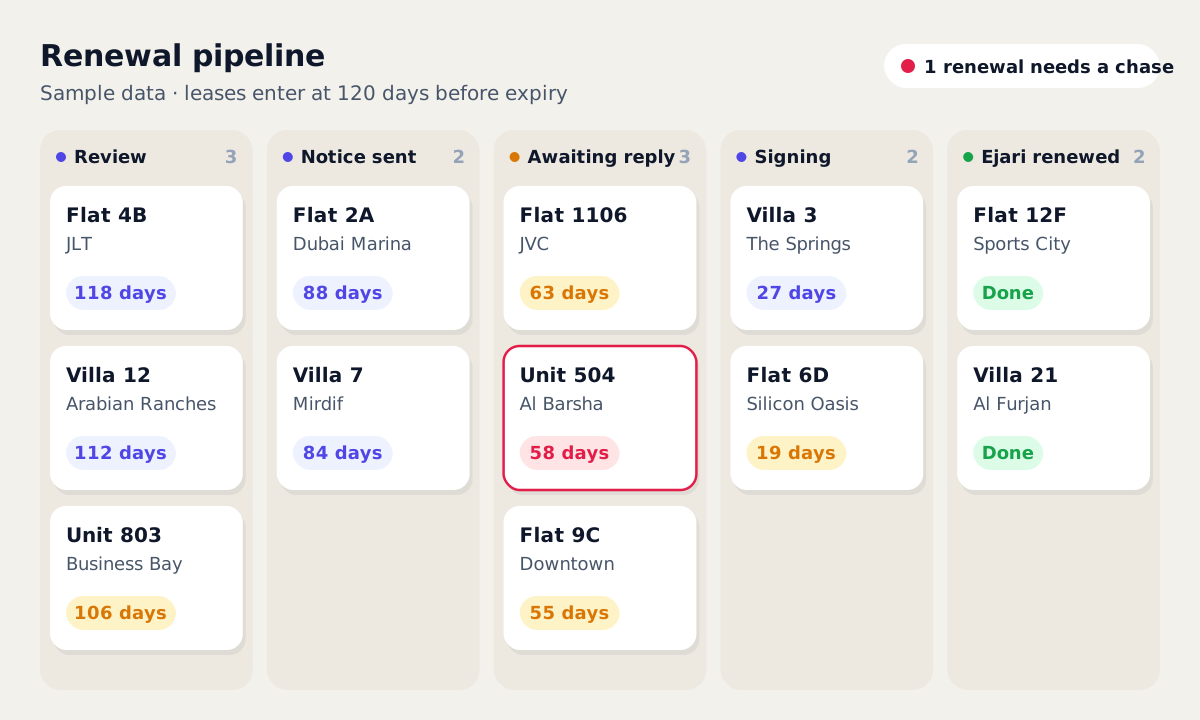
What the tool needs:
| Capability | Why it matters |
|---|---|
| Lease expiry dates on every tenancy | The pipeline is only as good as the dates in it |
| Automatic reminders at 120, 90, 60 and 30 days | Nobody has to remember to check |
| Renewal stages per lease | You can see where each renewal is stuck |
| Notice templates | Consistent, specific notices without rewriting each time |
| Ejari details and documents on the lease | The renewal file lives in one place |
| Rent schedule that updates on renewal | Reminders and statements use the new figures |
Comparing systems? Our guide to property management software in Dubai covers what else to check.
How Acreonix handles renewals
Acreonix is an AI operating system for UAE and UK agencies and property managers. Its property management software keeps tenants, landlords and leases in one place, with lease templates and e-signature, rent schedules, reminders and reconciliation. For UAE teams it includes Ejari registration details on each lease, RERA notice templates and 90-day renewal windows, and automations can fire when a lease is expiring. The Acreonix AI assistant can draft reminders and renew a lease after you confirm. If you also run sales and leasing, the Dubai real estate CRM shares the same records.
You can start free on the free-forever plan (3 units, 25 leads, no card needed), or book a demo to see a renewal pipeline built from your own leases.
Frequently asked questions
How much notice does a Dubai landlord need to give before renewal?
If the landlord wants to change the terms, including the rent, Dubai's tenancy law generally requires notice at least 90 days before the contract expires. Ending a tenancy is a separate process with its own grounds and a longer notice period. Check the current rules with the DLD or RERA.
How do I check the allowed rent increase in Dubai?
Use the official rental increase calculator published by the Dubai Land Department, available on its website and in the Dubai REST app. It compares the current rent with the official index and returns the maximum increase allowed.
Do I need to renew Ejari when a tenancy is renewed?
Yes, the renewed tenancy contract should be registered with Ejari so the record matches the new term. This can usually be done through the Dubai REST app or an authorised service centre. Check the DLD's current process and fees before you start.
What happens if nobody gives notice before the tenancy ends?
If the tenant stays on and the landlord does not object, the contract is generally treated as renewed on the same terms, for the same period or one year, whichever is shorter. So a landlord who misses the 90-day window may not be able to raise the rent for that term.
Can software register Ejari for me?
It depends on the product. Many systems record Ejari details and documents against the lease and remind you when renewal is due, while registration itself is completed through official channels. Ask each vendor what is integrated and what is manual.
Key takeaways
- A Dubai tenancy renewal means agreeing terms, giving notice of changes, signing the renewed contract and renewing Ejari.
- Changes to rent or terms generally need written notice at least 90 days before expiry, so start the process at 120 days.
- Rent increases are capped by reference to the official RERA rental index. Use the DLD calculator, not guesswork, and keep the result.
- Reset cheques, the rent schedule and the deposit at every renewal so reconciliation and landlord statements stay accurate.
- Track renewals as a pipeline with reminders at 120, 90, 60 and 30 days and a clear owner for each lease.
- Laws, calculators and Ejari procedures change. Check the DLD and RERA's current guidance and take advice for disputes.